
Train Hard. Protect Your Roots: Athlete Scalp and Loc Care for Starter Locs, Micro Locs, and Traditional Locs
Updated: May 5
If you work out regularly, your scalp needs a strategy, not guesswork.
Sweat alone is usually not the problem.
Sweat plus friction, trapped heat, product residue, tight maintenance, and slow drying are what create trouble.

Exercise-related sweating can temporarily change skin hydration, sebum, and surface pH; friction and occlusion can worsen breakouts and irritation; folliculitis is known to flare with perspiration, trauma, friction, and occlusion; and repeated tight styling can increase the risk of traction alopecia.
For active clients with locs, the goal is not perfection at all costs. The goal is a clean, calm scalp and loc maintenance that does not create new damage.
In most cases, a weekly scalp-focused wash rhythm is a better starting point than waiting too long between cleanses, especially if you sweat often, wear helmets or headbands, or notice itching, flakes, or tenderness.
AAD guidance recommends washing based on how dirty or oily the scalp gets, gives once-weekly or every-other-week washing as a common baseline for Black hair, and notes that dry shampoo does not replace regular shampoo and water. A peer-reviewed wash-frequency study also found better scalp outcomes with more frequent cleansing in the study population, though that was not loc-specific and still has to be adjusted for texture and style.
NOTE:
When I reference guidance from the American Academy of Dermatology (AAD), I’m referring to one of the most trusted dermatology organizations in the country. The AAD represents thousands of physicians who specialize in skin, hair, and nail health, and their guidance is considered reliable because it is built on scientific research, physician expertise, and a formal review process. That matters when we’re talking about scalp irritation, inflammation, fungal overgrowth, buildup, and hair loss, because those topics sit at the intersection of beauty care and medical scalp health.
Why scalp inflammation and fungal issues matter for athletes
This is the part many active clients miss: a neat re-twist can still sit on top of an irritated inflamed scalp.
When sweat stays trapped under wraps, helmet bands, or residue, athletes can experience scalp itch, flakes, tenderness, clogged follicles, and bumps that are easy to mislabel as “just dry scalp.”
Seborrheic dermatitis commonly causes itchy, flaky, scaly patches on oily areas like the scalp. Scalp psoriasis can show up as thick, inflamed, silvery scale with temporary hair loss. And tinea capitis, also called scalp ringworm, is a fungal infection that can cause swollen or scaly patches, itch, and hair loss and often requires oral antifungal treatment.
Key takeaway: salon care can reduce triggers, remove buildup, and help you spot warning signs early, but true fungal infections and inflammatory scalp disease need medical diagnosis and treatment. That is why persistent itching, pustules, crusting, bleeding plaques, or patchy hair loss should never be ignored.
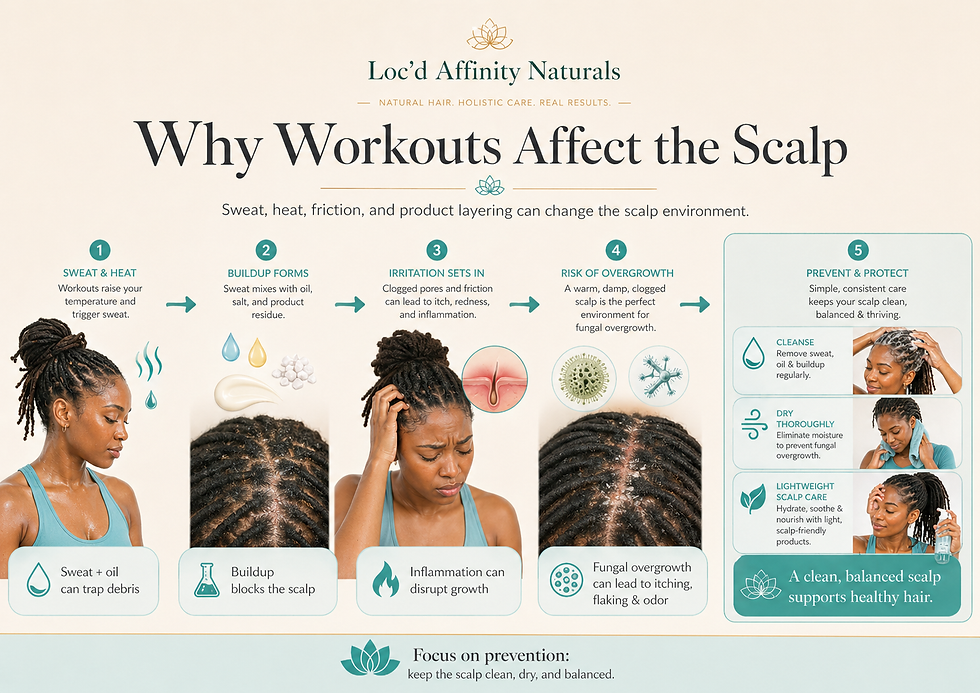
How sweat, friction, and frequent washing affect scalp health and loc integrity
Sweat changes the skin environment. In a controlled study, exercise-induced sweating significantly affected surface hydration, sebum, and skin pH. In real life, that matters most when sweat meets friction, trapped heat, and residue. AAD athlete guidance warns that workouts, tight clothing, and sports equipment can worsen acne and irritation through rubbing and sweat retention. Merck also notes that folliculitis is potentiated by perspiration, trauma, friction, and occlusion.
Frequent washing is often blamed, but rough handling is usually the bigger issue for loc clients.
AAD notes that wet hair breaks more easily when combed or brushed, and hair-shaft research shows high heat can damage the fiber.
For locs, that means the best practice is scalp-focused cleansing, minimal rough rubbing, blotting instead of aggressive towel work, and fully drying the roots and lengths before sleep, hats, helmets, or styling.

These are practical salon starting ranges, not one-size-fits-all rules. Adjust for scalp symptoms, density, climate, helmet use, swim exposure, hard-water exposure, and medical history. The ranges are informed by AAD wash guidance for textured hair, traction-risk guidance, athlete friction/occlusion guidance, and wet-hair fragility guidance.
Tailored routines for starter locs, micro locs, and traditional locs
Starter locs need cleansing without panic. At home, focus shampoo on the scalp, let water and lather move through the locs without rough scrubbing, blot with a clean towel or T-shirt, and dry completely. In salon, prioritize scalp analysis, low-residue cleansing, and low-tension re-twisting.
If the roots are painful, the maintenance is too tight.
Micro locs usually show tension and buildup faster because the sections are small and the perimeter can be more vulnerable. At home, weekly scalp cleansing is often the most realistic plan for active clients, with scalp-only anti-dandruff shampoo used as needed for flakes or persistent itch. In salon, monitor the hairline, reduce over-tight reties, and add buildup control when sweat, hard water, or heavy product use are part of the routine.
Traditional locs can tolerate a little more visual frizz, but they cannot tolerate chronic residue or staying damp for long periods. At home, prioritize a full dry-down after every wash. In salon, periodic clarifying or chelating support makes sense when you see stubborn buildup, hard-water exposure, or swim-related residue. If the ends are color-treated, brittle, or compromised, add a reparative treatment only where needed.
If your salon uses Malibu C Head Lab, that workflow fits athlete clients well because it combines close-up scalp imaging with buildup-focused service steps and home-care support. Malibu’s official materials describe the Digital Scope as a real-time, close-up tool with photo/video capability and 50x to 1,000x magnification for before-and-after tracking.
Malibu also positions Un-Do-Goo as a clarifying buildup remover, Crystal Gel XL as a scalp-and-hair treatment for minerals, metals, and buildup, Scalp Scrub as a drug-free exfoliating scrub, B5 Revitalizer Mist as lightweight hydration with vitamin B5 and allantoin, and Miracle Repair with Cooling Menthol as a soothing reparative treatment. Malibu also makes clear that scalp scrub products are not intended to treat medical conditions.

Timing your care around training
The smartest wash day is usually after your heaviest sweat day or before your next recovery window, so the scalp gets clean and the locs have time to dry fully.
The smartest maintenance day is usually a lighter training day or rest day, not the day before a helmet-heavy practice, competition, or long outdoor session if your scalp tends to feel tender after tightening.
Do not stack a painful re-twist on top of friction-heavy training.
Quick pre- and post-workout checklist
Before workouts, use a clean, breathable, moisture-wicking wrap, scarf, or helmet liner, and skip heavy oils, butters, or thick stylers on the scalp.
After workouts, pat sweat away, dry the roots and perimeter, and do not cover damp locs. Wash wraps, towels, and helmet liners often. If you use dry shampoo in a pinch, remember that it is a bridge product, not a scalp-cleaning substitute.
Signs that need medical referral
Refer out when you see or feel pustules, pus, crusting, painful bumps, spreading redness, swollen boggy patches, bleeding plaques, scaly bald spots, unusual shedding, crown thinning, or a recession pattern that suggests traction alopecia. Folliculitis, scalp psoriasis, seborrheic dermatitis, and fungal scalp infections can overlap visually, and some require prescription therapy or diagnostic evaluation.

Final call to action
If you are an athlete looking for scalp care for locs, work out consistently, or live in headbands, wraps, or helmets, your scalp deserves the same level of strategy as your training plan.
Book a scalp analysis or athlete-friendly scalp wellness service so we can identify buildup, reduce friction and inflammation triggers, protect your locs, and create a wash-and-maintenance routine that actually fits your life.


Comments