
Loc Repair Isn't Hair Restoration: What Really Happens When Your Locs Break?
A loc repair is a reinforcement—not a resurrection.
When a loc becomes thin, breaks, or detaches, it is natural to want it restored. Whether you wear traditional locs or microlocs, you have invested time and care into growing your hair. Many damaged locs can be repaired or reattached, but making a loc look whole again is not the same as restoring its original structure.
As a licensed cosmetologist specializing in loc care, I have seen how beautiful a repair can look immediately after an appointment—and how that same repair can become compromised when the underlying cause of damage has not been addressed.
Your Locs Are a Structure Made of Hair Fibers
Think of a loc as a piece of fabric. Individual hair strands, including naturally shed hairs, become intertwined and compacted over time. Not every strand in a mature loc remains attached to the scalp. Like fabric, the structure can be damaged by friction, pulling, cutting, chemical processing, and repeated manipulation. When enough fibers are damaged or lost, a loc may thin or break.
Why Traditional Locs and Microlocs Break
Tight styling and repeated tension: Braids, weaves, extensions, ponytails, and other styles worn over locs may create friction and tension. Removing extensions can also accidentally cut the locs underneath. Protective styling should protect the hair, not repeatedly stress it.
Dryness, brittleness, and conditioning: Brittle hair fibers can snap and gradually separate from a loc. Conversely, heavily lubricating products may leave some immature or recently repaired locs soft, fluffy, or less compact. This does not mean water or conditioner is inherently damaging. The right routine supports both flexibility and structure.
A soft loc isn't automatically a strong loc, and a firm loc isn't automatically a healthy one.
What Actually Happens During a Loc Repair?
Loc maintenance manages new growth. Loc repair reinforces thinning, unraveling, or compromised sections. Reattachment joins a detached loc segment to viable supporting hair. Crochet techniques mechanically draw fibers together; they cannot biologically reconnect severed hair shafts. A repaired section relies on the remaining fibers and the mechanical connection created during service.
The following example shows two existing locs being combined. It is a loc combination and reconstruction, not a detached-loc reattachment. The after image documents the immediate appearance rather than long-term durability.

BEFORE — Two existing locs prior to combination.
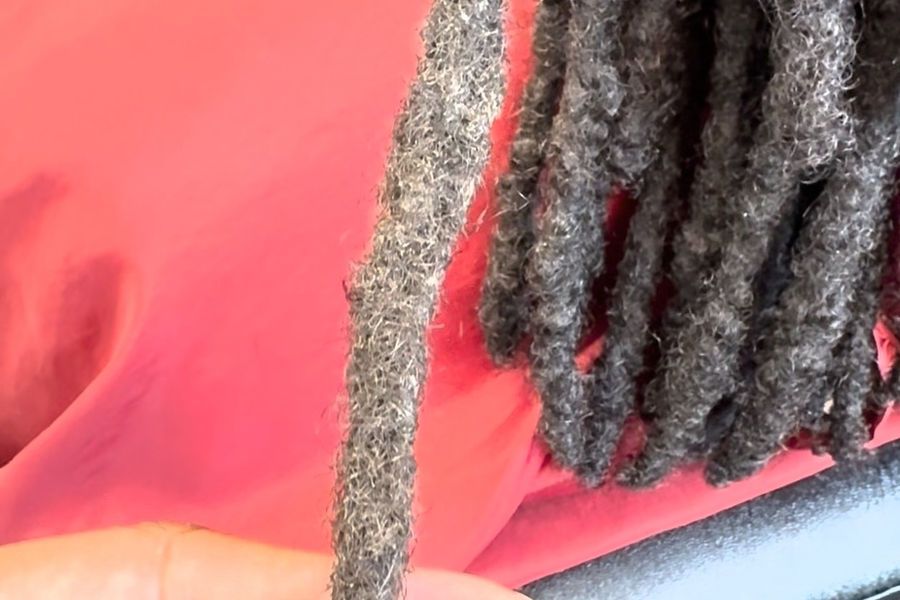
AFTER — Immediate appearance following combination into one more continuous loc.
The Second Locking Phase: Why Repairs Need Time
I sometimes call the period after reconstruction a second locking phase. Reintroduced loose fibers may gradually settle, entangle, and compact within the repair. This is my practical analogy, not a formal biological stage. A connection can become more integrated over time, but original strength and permanence are never guaranteed. Avoid unnecessary pulling and tension while a repair settles.
Why Some Loc Repairs Fail
Too much added hair: Adding Afro-textured or braiding hair may reconstruct a damaged section, but extra hair also adds weight. A fuller-looking loc can still be supported by too few viable fibers.
More hair is not always more reinforcement. Sometimes it is simply more weight on a compromised foundation.
Excessive crocheting: Repeated passes, unsuitable hook sizes, snagging, and excessive tension may damage individual hair fibers—especially in already fragile areas or microlocs. The goal is to secure the repair, not crochet until every loose strand disappears.
Thread-only reattachments: Cotton or nylon thread can provide supplemental support in some methods, but thread alone does not necessarily restore structural integrity. Stitches may shift or become exposed, and concentrated tension can stress supporting fibers.
Technique and hair condition matter.
Glue: At Loc'd Affinity, I do not use glue to reconstruct or reattach locs. Some bonding adhesives may soften with removers or leave residue; harder adhesives can create rigid areas and complicate future repair. I prioritize the existing hair fibers and the long-term condition of the hair and scalp.
Why Repairs May Loosen After Washing or Conditioning
Hair swells when wet and changes dimensions as it dries. Conditioning ingredients can change friction between fibers. Depending on the repair method, these changes may contribute to movement or slippage. I have observed repairs loosen after changes to a client's conditioning routine, but that observation does not prove conditioner caused every failure. Follow individualized aftercare guidance rather than avoiding conditioning altogether.
When Repair Isn't the Right Answer
Sometimes the most responsible choice is not to perform a repair. Ongoing thinning, active inflammation, or insufficient supporting hair may make reattachment unsuitable. When medical scalp conditions or active hair loss are suspected, I may recommend evaluation by a dermatologist. A diagnosis alone is not an automatic disqualification; the question is whether the hair and scalp are stable enough to support the proposed service.
Protecting the foundation of your locs matters more than preserving their length at any cost.
Why Loc Repair and Maintenance Are Different Services
A routine retie or retwist is not structural reconstruction. Multiple weak sections, detached locs, and extensive fiber incorporation take additional assessment and time. Some repairs can be completed alongside maintenance; others require a separate appointment or multiple sessions. Tell your stylist about breakage or thinning before your visit so the correct service and time can be reserved.
How to Protect Repaired Locs
Avoid tight styling, heavy extensions, unnecessary twisting or pulling, and rough removal of protective styles. Follow an individualized cleansing and conditioning routine, and have new thinning or repeated slippage assessed early. A repaired loc may look whole before it is ready for the same stresses it previously tolerated.
Caring for the Crown You Have
Locs are resilient, but they are not indestructible. A successful repair is not simply about hiding damage: it is about making thoughtful decisions that preserve the hair you still have.
At Loc'd Affinity, my approach begins with assessing the hair and scalp, identifying possible contributors to damage, and determining what the remaining hair can reasonably support.
The goal isn't just to make your locs look whole today. It's to help you care for the crown you'll continue wearing tomorrow.
Concerned about thinning, breakage, or detached locs? Schedule a Hair & Scalp Consultation with Loc'd Affinity to discuss whether repair, maintenance, or further evaluation is appropriate.


Comments